Why your mini split blows cold air in South Dakota

Describe what your mini split is doing once, in one form.

Skip the calls

A mini split blowing cold air when it should be heating usually means it's stuck in cooling mode or the thermostat setting got switched by mistake. Check the mode button on the remote first. If it's already set to heat and the air still feels cold, the unit may be in defrost mode, which is normal in winter and only lasts a few minutes. If cold air keeps coming for longer than that, the problem is likely inside the unit: a failing reversing valve, a refrigerant leak, or a control board that isn't telling the system to switch modes correctly. Since most homes in South Dakota heat with gas, a mini split is often there for shoulder season comfort or secondary heat, so a unit stuck blowing cold can leave a room without backup heat on a cold morning. A reversing valve or sensor problem doesn't fix itself and gets worse the longer it runs that way.

A dim room with a wall-mounted mini-split air conditioner above a faint vertical stain running down the wall, a folded grey towel on the wood floor at the baseboard, and a desk with monitor, lamp, small plant and office chair by a window.

You're at your desk on a warm afternoon, the kind South Dakota gets without the thick air hanging on it, and the mini split above the window has been running since lunch. You notice the wall first, a dark streak soaking down from the indoor unit toward the baseboard. Then the towel you grabbed an hour ago, already soaked through on the floor beneath it. The air coming out still feels cold, not the problem you came in here to fix. You stand there a second, listening to it run, wondering how long the water's been getting behind the wall and not just onto the floor.


Frozen Coil or Control Fault

Frozen coil

  • A dirty filter or blocked intake restricts airflow over the indoor coil, and the coil ices up instead of absorbing heat.
  • Once ice forms, the air coming out feels cold no matter what the remote says, because the coil can't pull warmth from a block of ice.
  • Low refrigerant does the same thing, dropping coil temperature below freezing even when outdoor conditions aren't extreme.
  • Running the fan without heat for a while will not clear it, since the ice has to melt off the coil itself.
  • A contractor who services these units regularly in South Dakota can confirm whether it's airflow, charge, or both before opening anything up.

Wrong mode or control fault

  • The unit can be stuck in cooling or fan-only mode even though the display reads heat, especially after a power blip or remote battery swap.
  • A failed reversing valve keeps the system running in cooling mode internally no matter which setting you choose on the remote.
  • Outdoor temperatures around freezing can trip a defrost cycle, and the indoor unit blows cold air on purpose for a few minutes while it clears frost from the outdoor coil.
  • If the remote's mode setting won't hold or the unit doesn't respond to commands, the control board or sensor may be at fault.
  • This kind of problem usually needs a licensed technician to diagnose correctly rather than guesswork with the remote, since swapping the wrong part wastes money and time.
A white wall-mounted mini-split air conditioner installed high on a beige interior wall near the ceiling, with a sheer curtain and window at the left edge.

Running the way it should

Air moves out even and steady, and the wall under the unit stays clean and dry. The louvers open and close on command. If yours looks like this and still blows cold on heat mode, the problem is in the switch or the sensor, not the airflow.

A white wall-mounted mini-split air conditioner indoor unit with visible dust and discoloration, installed near the ceiling on a plain beige wall.

Dust and discoloration like this mean trouble

Dust on the housing and a stained vent usually point to a coil that hasn't been cleaned in a while, or a filter that's been restricting airflow for months. That buildup is what lets ice form on the coil, and ice is what turns warm air cold on its way out. A contractor who services mini splits every season in South Dakota will know within a few minutes whether this one needs a clean and a recheck or something more.

A gray-haired man in a dark sweater sits on a light gray sofa in a living room, looking toward a sunlit window with trees outside.
A gray-haired man in a dark blue sweater sits on a light gray sofa in a sunlit living room, looking off to the side, with a potted plant, shelving unit, and large glass doors behind him.
A bearded man with graying hair in a dark green sweater sits on a sofa in a living room, looking off to the side, with a sliding glass door and a dim kitchen doorway behind him.
A gray-haired man in a dark knit sweater sits on a light gray sofa in a living room, looking toward a sunlit window, with houseplants, a lamp, and framed art in the background.
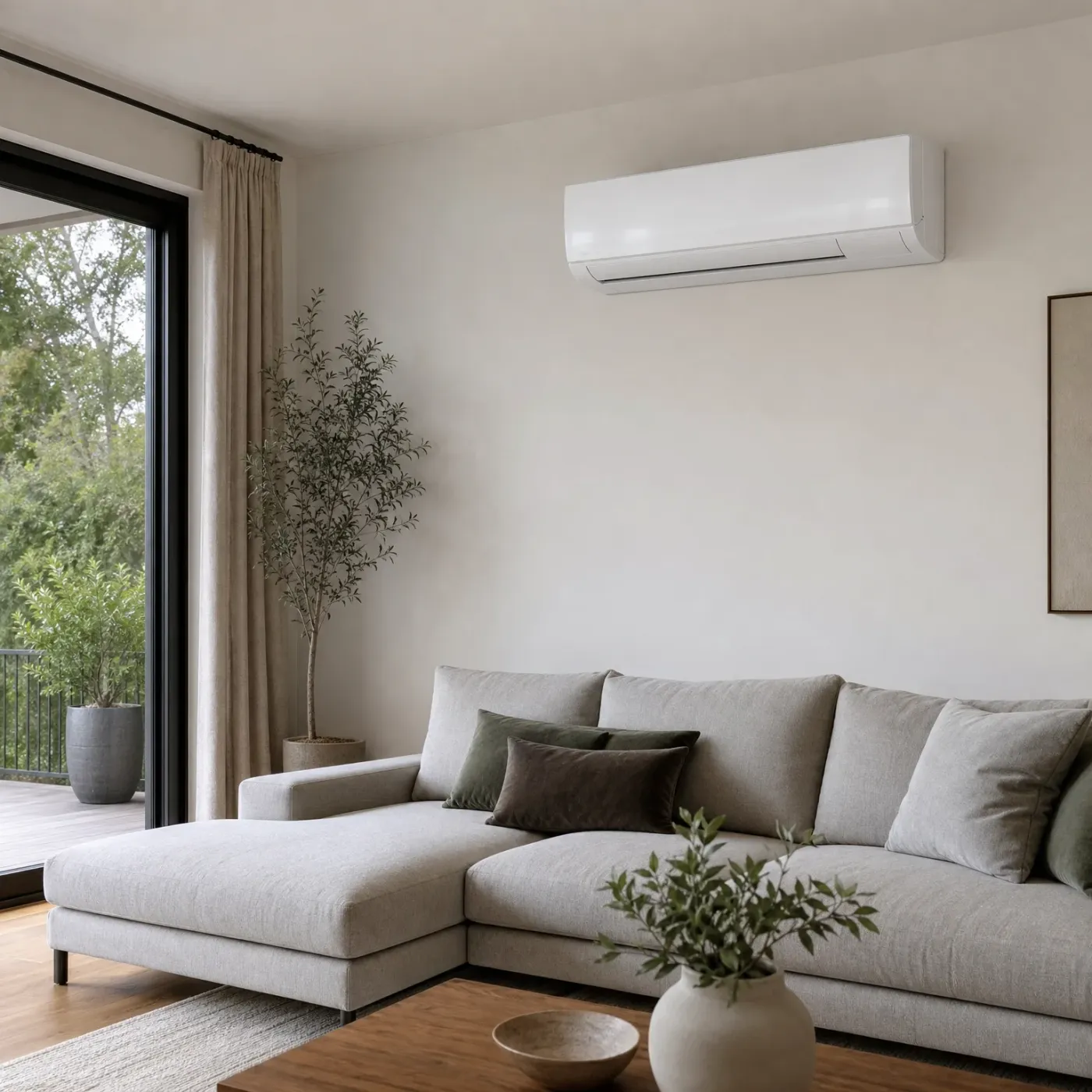
Living room with a grey sectional sofa, wall-mounted white mini-split air conditioner above it, a potted tree beside sliding glass doors with beige curtains, and a wooden coffee table with a vase of foliage in the foreground.

No phone calls to make

The pro who reaches out is licensed in South Dakota.

Skip searching for a mini split pro and answer a few questions instead.

Get one local pro

Asking costs nothing, and the choice to hire stays yours.

A closed dark laptop and a ceramic mug of coffee on a wooden dining table, with wooden chairs, a dark kitchen cabinet with cutting boards and a potted plant, and a leafy plant by a window in the background.

How a mini split decides which way to send the heat

A mini split doesn't burn anything to make heat. It runs refrigerant through a reversing valve, and that valve decides which coil, indoor or outdoor, absorbs heat and which one releases it. Flip the system to heat mode and that valve has to physically switch position. If it sticks, even partway, the system keeps pulling heat from inside and pushing it outside, which is exactly backward from what the remote is telling it to do. You'll feel that as cold air with the thermostat set to warm.

That valve isn't something you can see or test from the wall unit, and it's not something to guess at over the phone with three different companies while you describe the same streak on your wall three times. A contractor who services mini splits in South Dakota through both the mild summers and the real cold knows the reversing valve is one of the first things to check when heat mode blows cold, and can confirm it with the right gauges instead of a process of elimination.

A living room corner with a beige sofa and cushion, a round wooden coffee table holding a pale ceramic vase of eucalyptus stems and a wooden bowl, and a curtained window with a potted plant above a latticed radiator cover in the background.
A white wall-mounted mini-split air conditioner installed high on a beige interior wall below crown molding, with a sheer white curtain on a dark rod at the left edge.

Working normally

Air comes out at the temperature the remote says, warm on heat mode, cool on cooling mode. The casing stays clean, the louvers move freely, and there's no smell or streak on the wall below it. If yours looks like this but still blows cold air on heat mode, the fix is likely the reversing valve or a sensor, not the unit itself.

A dusty white wall-mounted mini-split air conditioner unit installed near the ceiling on a plain light-colored interior wall, with a small recessed ceiling fixture at upper left.

Needs a look

Dust and grime built up on the casing like this usually mean the filter hasn't been cleaned in a while, and the same buildup is probably on the coil behind it. A coil caked in dust can't absorb heat the way it should, so the unit blows cold air no matter what mode it's set to. A contractor who services these units regularly can tell from the grime alone roughly what's wrong before opening the panel.

Power costs 13.32 cents per kilowatt-hour statewide

At 13.32 cents a kilowatt-hour, running a mini split here doesn't punish you the way it might elsewhere. That's good reason to get a stuck reversing valve or a bad sensor fixed instead of living with a space heater plugged in next to it, since the unit itself isn't the expense.

EIA-861 2025 statewide residential average

What to do about it

  • Cold air on heat mode almost always traces to the reversing valve, a stuck sensor, or the mode setting itself.
  • A dirty filter or iced coil can make a working unit feel like it's blowing cold even when the valve is fine.
  • Checking the mode button and the wall underneath the unit tells you more in a minute than guessing ever will.
  • Gas heat in most South Dakota homes means the mini split is likely doing secondary duty, so a stuck unit is easy to ignore until it isn't.
  • Cheap power here makes fixing the valve or sensor the better call over running a space heater as a workaround.
  • A local contractor who services these units every season has usually already seen whatever yours is doing.

A mini split that blows cold on heat mode is telling you something specific, not failing at random. Most of the time it's the reversing valve stuck in the wrong position, a sensor sending the wrong reading, or the mode setting itself got bumped. Sometimes the unit is actually heating fine and a dirty filter or an iced-over coil is choking the airflow enough that what comes out feels cold anyway. The mode button and the wall underneath the unit will tell you which one you're dealing with faster than any amount of guessing. Since gas heat carries most homes through a South Dakota winter, the mini split is often just filling in the gaps, which is exactly why a stuck valve can go unnoticed for weeks before someone finally feels the cold air and wonders what's wrong. With power here running around 13 cents a kilowatt-hour, there's little reason to live with a space heater as a workaround while the real problem sits unfixed. Once you know what you're looking at, the next step is getting it in front of someone who works on these systems regularly, rather than calling around and explaining the same symptoms to three different companies. A contractor who services mini splits through every South Dakota season has likely already seen this exact fault, on this exact kind of unit, and knows what to check first.

A middle-aged woman with shoulder-length dark hair, wearing a gray cardigan over a cream top, sits in an upholstered armchair and looks toward a sunlit window, with a shelf holding framed pictures and a plant behind her.
A woman with her hair in a bun holds a sleeping young child against her chest, both wrapped in a textured beige knit blanket on a sofa in a dimly lit room with a lamp, framed picture, and bookshelf behind them.

Mini Split Repair

One form, no calling around

Only one pro gets your request, so you hear from one company.

A black-framed smartphone standing upright against a plain white background, its screen filled with solid green.
Step 1 of 3: Equipment